Our process
Agreed up front. Reviewable throughout
Six stages, from understanding the business to improving the system once it runs. Requirements, acceptance criteria and change handling are set before work begins, and source code, accounts and documentation are yours at the end.
Six stages
Six stages, one accountable team
Every engagement moves through the same sequence, whatever its size, and each stage ends in something you can review. Choose a stage, or let the film run.
Stage 01 of 06
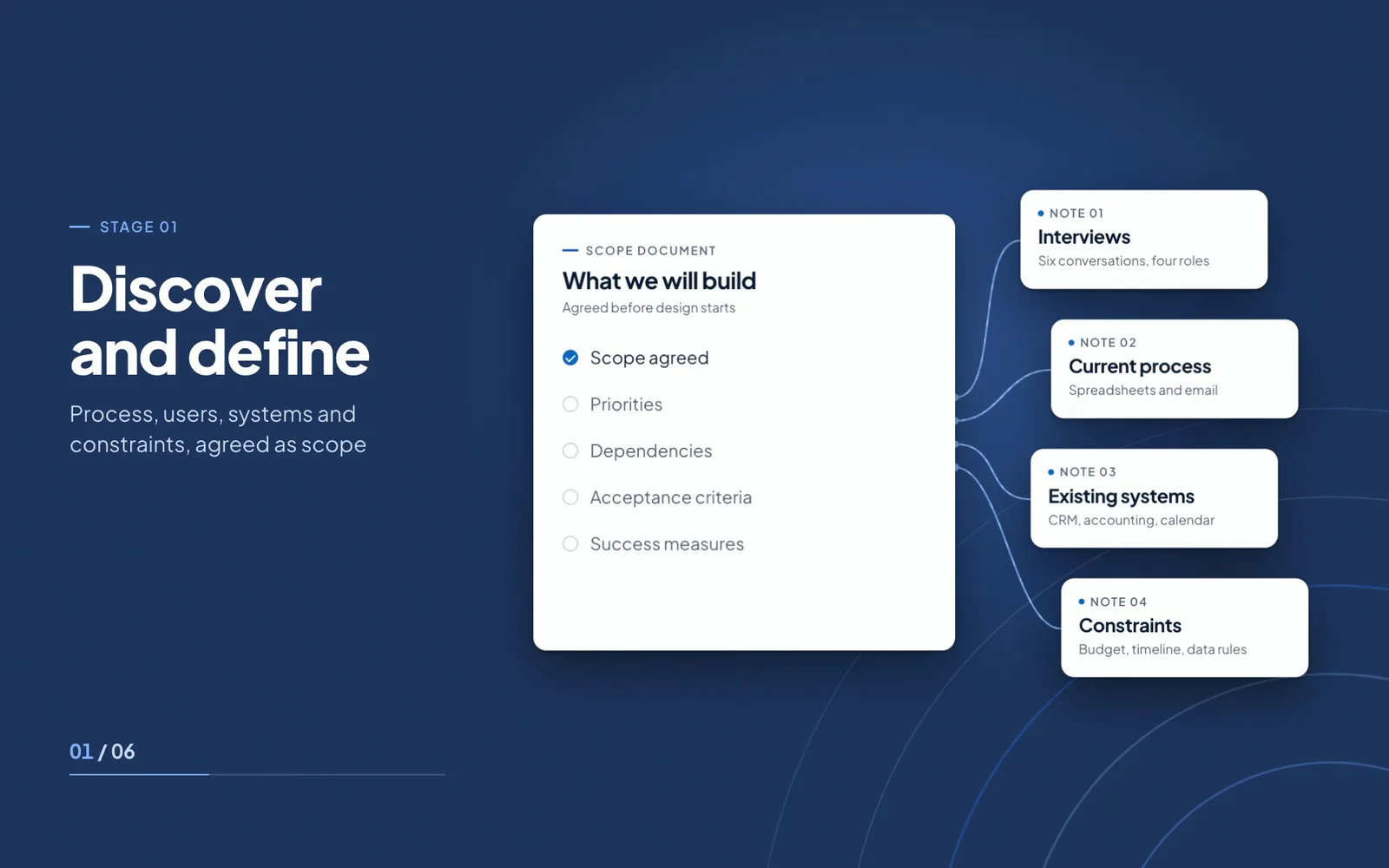
Discover and define
Understand the process, users, existing systems and constraints. Agree scope, priorities, dependencies, acceptance criteria and how success will be measured.
- Workshops, stakeholder interviews and a review of the current process
- Systems reconnaissance: applications, vendors, workflows, data stores, spreadsheets and workarounds
- Pain points and opportunities mapped, including where AI adds value and where people must approve
- Feature inventory and priorities: must-have, next stage, future
- A practical first release defined, with acceptance criteria and success measures
Engagement models
Start where the risk is lowest
Work can begin with a free recommendation on the challenge you send us, a single workflow, a technical discovery engagement or a complete platform, then expand as requirements develop.
- 1
A free recommendation
Tell us the challenge. A person who builds these systems replies with a written, no-obligation recommendation: what to fix first, and how.
- 2
Discovery and technical planning
Requirements, feasibility, architecture and a delivery roadmap. A short, defined engagement that de-risks a larger build.
- 3
Defined project delivery
A scoped system, integration, agent or workflow with agreed milestones and acceptance criteria.
- 4
Phased product development
A prioritised first release followed by improvements informed by real use.
- 5
Ongoing development and support
An agreed programme of maintenance, integration work and enhancement.
What you receive
The system, and everything needed to own it
Depending on scope, an engagement includes the working system and everything needed to own and run it.
- Requirements and workflow documentation
- Prototypes and interface designs
- Application source code and agreed access
- Data models and migration procedures
- Integrations and automation workflows
- Configured deployment environments
- Validation and acceptance records
- User guidance and operational documentation
- Training and an agreed support plan
Success measures may include administrative time, task completion, response speed, data accuracy, conversion or operating cost. They are selected for the project and assessed against an agreed baseline where one exists.

Next step
Tell us about the challenge you want to solve
A person who builds these systems reads it and replies with a free, no-obligation recommendation within two business days. You don't have to start with everything.